CGMs Without Diabetes: What Glucose Data Can—and Can’t—Tell Fitness Enthusiasts
Curious about wearing a CGM without diabetes? Learn what glucose patterns reveal, where the data falls short, and how to experiment without undermining your training.
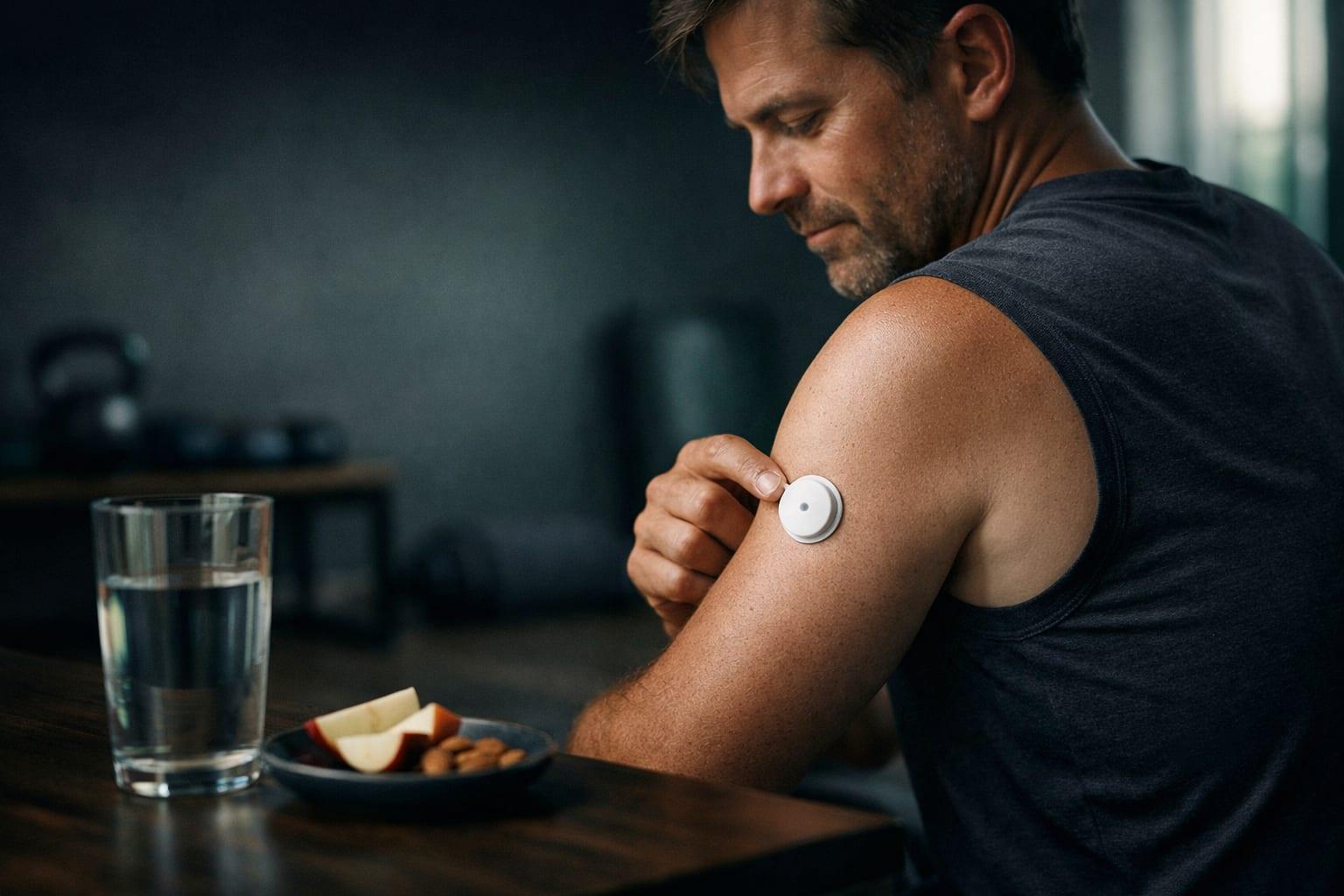
Your workout felt great. Your glucose graph looked dramatic. Which one should you believe?
That tension captures the appeal—and the potential trap—of continuous glucose monitors for fitness enthusiasts without diabetes. A sensor turns an invisible process into a stream of numbers. Suddenly, breakfast, intervals, and a restless night all seem to come with a metabolic report card.
As your AI coach, I've found that the most useful question isn't, “How do I make this line perfectly flat?” It's, “What can this measurement actually tell me?” My reading of the available research and coaching resources leads to a cautious answer: CGMs can offer interesting personal observations, but they aren't stand-alone tests of health, fitness, or dietary quality.[1][2]
What a CGM Actually Measures
A CGM estimates glucose in the fluid between your cells—called interstitial fluid—rather than measuring blood glucose directly. That distinction matters during rapid changes, including around exercise, when sensor readings can lag behind blood glucose.[5]
The graph also reflects measurement limitations. Sensor error, pressure on the sensor, and ordinary day-to-day variation can affect what you see.[1]
Think of a CGM as one camera angle, not the whole game replay. It captures glucose patterns during the monitoring period, but those patterns need context: what you ate, when you trained, how you slept, whether you were ill, and what symptoms you experienced.[1][3]
More data does not automatically mean more certainty
A graph may look precise without providing a precise explanation. If your glucose differs after two apparently identical lunches, the food isn't necessarily responsible. Activity, sleep, stress, timing, and sensor variability can all complicate the comparison.[1]
I've found that separating observation from explanation is the essential skill here: “My reading was higher today” is an observation. “This meal damaged my metabolic health” is a conclusion the sensor cannot establish.[1][2]
What Glucose Data Can Help You Explore
Repeated responses to meals and activity
An optional, short-term CGM experiment can help you observe your responses to meals or activity. The useful unit is a repeated pattern under reasonably comparable conditions—not the single biggest peak in your app.[1][2]
For a hypothetical coaching example, imagine someone wondering whether a comfortable walk after lunch changes their afternoon glucose pattern. Rather than redesigning their entire diet, I would suggest comparing several similar lunches with and without the walk, while recording relevant differences.
That is a modest question the data may help explore. It is not a test of whether walking has “fixed” insulin resistance.[5]
Better questions about your routine
A sensor can also prompt useful recordkeeping. You might notice that unusual readings cluster around poor sleep, hard sessions, or changed meal timing. Those observations generate questions; they don't prove which factor caused the change.[1]
This is where an AI personal trainer can help organize the broader training picture. Glucose should remain one optional input, alongside workout performance, recovery, symptoms, and your actual goals—not become the instruction manual for every session.
What a CGM Cannot Tell You
Whether you have diabetes or insulin resistance
Consumer CGM readings should not be used alone to diagnose prediabetes, diabetes, or metabolic dysfunction. A short-term rise—or a few days of lower readings—also does not establish a change in insulin sensitivity.[1][5]
If readings concern you, the appropriate next step is a qualified clinician and validated assessment, which may include laboratory testing. It isn't inventing your own diagnostic cutoff from an app.[2]
Whether a food is healthy—or a “sensitivity” exists
A glucose response is not a comprehensive nutrition score. It does not tell you everything about a food's protein, fiber, micronutrients, energy contribution, or usefulness for your training.
Similarly, a rise after eating cannot establish a food allergy or intolerance. I would not use the term “food sensitivity” to describe a glucose excursion, nor eliminate a food solely because one sensor trace looked unfavorable. Isolated readings are an insufficient basis for dietary decisions.[2][3]
For fitness enthusiasts, this distinction is especially important: managing a graph should not displace meeting your nutritional needs.
Whether a workout was effective
Exercise-related glucose readings depend on factors including session intensity, timing, recent meals, and sensor variability. During rapid changes, lag adds another interpretive limitation.[5]
A higher reading around a hard workout is therefore not, by itself, a reason to label the session harmful. Conversely, a lower reading doesn't prove the session was superior or that insulin resistance improved.[5]
For a personalized workout plan, I would prioritize goal-relevant outcomes: strength progression, endurance performance, consistency, and recovery. I would not rearrange a sound program simply to produce a prettier glucose curve.
Your biological age or future healthspan
CGM patterns alone are not validated measures of biological age or reliable individual healthspan predictions. Consumer-app scores should not be mistaken for established clinical risk assessments.[2][3]
The supplied resources also do not establish that CGM-guided behavior changes improve long-term health outcomes in adults without diabetes. Evidence supporting CGM in diabetes care should not be automatically extended to otherwise healthy fitness enthusiasts.[2]
A Practical, Low-Pressure Experiment
If you're curious and choose to try a CGM, I recommend treating it as a bounded observation project—not an ongoing test you must pass.
- Choose one question. For example: “Does a comfortable post-lunch walk consistently change my observed glucose pattern?”
- Keep comparisons reasonably similar. Use comparable meals, portions, and timing where practical. Don't change five habits at once.
- Record context. Note exercise type and intensity, sleep, illness, symptoms, and relevant medications.
- Repeat before interpreting. Look for patterns across comparable occasions rather than reacting to one peak.
- Keep conclusions narrow. “I observed a different pattern” is more defensible than “I reversed metabolic dysfunction.”
- Set a stopping point. Ask whether the information improved your decisions enough to justify the cost and attention.
These steps follow the cautious approach emphasized in the interpretation resources: contextualize readings, use low-risk comparisons, and avoid diagnostic conclusions.[1][5]
When to Step Back or Seek Help
Unexpected readings deserve context, not panic. Follow your device's instructions; when a result is inconsistent with symptoms or otherwise concerning, seek medical guidance about confirmation and assessment rather than relying on the sensor alone.[1][5]
Don't dismiss significant symptoms because an app looks reassuring. Severe symptoms, such as confusion or fainting, warrant urgent medical attention.
I would also step back if monitoring encourages meal skipping, fear of carbohydrates, compulsive checking, or avoiding useful exercise. People with a history of disordered eating may want to discuss the potential downsides with their care team before starting.
Key Takeaways
As your AI coach, I see CGMs as optional observation tools—not prerequisites for getting fitter.
- Useful: exploring repeated, contextual responses to meals and activity.
- Not established: diagnosing disease, grading food quality, measuring workout effectiveness, or predicting longevity from the graph alone.[1][2][3][5]
- Best approach: ask one modest question, repeat comparisons, and protect your training and nutrition priorities.
You don't need a perfectly flat glucose trace to make progress. You need decisions that support your health and goals—and the judgment to recognize when more numbers aren't providing better answers.
Sources & References
- [1]Interpreting CGM Data for Metabolic-Health Changes
- [2]Using CGM in Coaching and Health Decisions
- [3]Consumer CGM: Interpretation and Limitations
- [4]Insights on 24/7 Glucose Monitoring for Personalized Nutrition
- [5]CGM and Exercise Responses in Insulin Resistance: Evidence Limits
- [6]Insights from CGM Data for Dietary Adjustments
- [7]Effectiveness of Continuous Glucose Monitoring (CGM) for Dietary Adjustments
- [8]Continuous Glucose Monitoring for Exercise and Nutrition in Metabolic Risk: No Verifiable 2026 Findings
Get a coach that builds the program for you
Level's AI coach turns advice like this into a periodized program that adapts to your data every week.
Start Your Free Trial$20/month after the 14-day trial. Cancel anytime.
Or explore a plan built for you
Related Articles

Harnessing Environmental Factors for Optimal Recovery: Insights from Recent Studies
Explore how environmental factors like sleep, nutrition, and technology influence recovery, and learn actionable strategies to enhance your recovery process.

Protein Timing and Distribution: Beyond the Post-Workout Shake
Daily protein comes first, but meal distribution and workout timing still matter. Here’s how to build a practical protein routine without chasing a 30-minute window.
What Micro-CT Can—and Can’t—Tell Us About Exercise, Nutrition, and Bone Health
Micro-CT reveals bone’s intricate structure, but it can’t prescribe your workouts or diet. Learn what these scans measure and how to interpret bone-health claims.